1. The first transmission channel: pressure on the broader economy
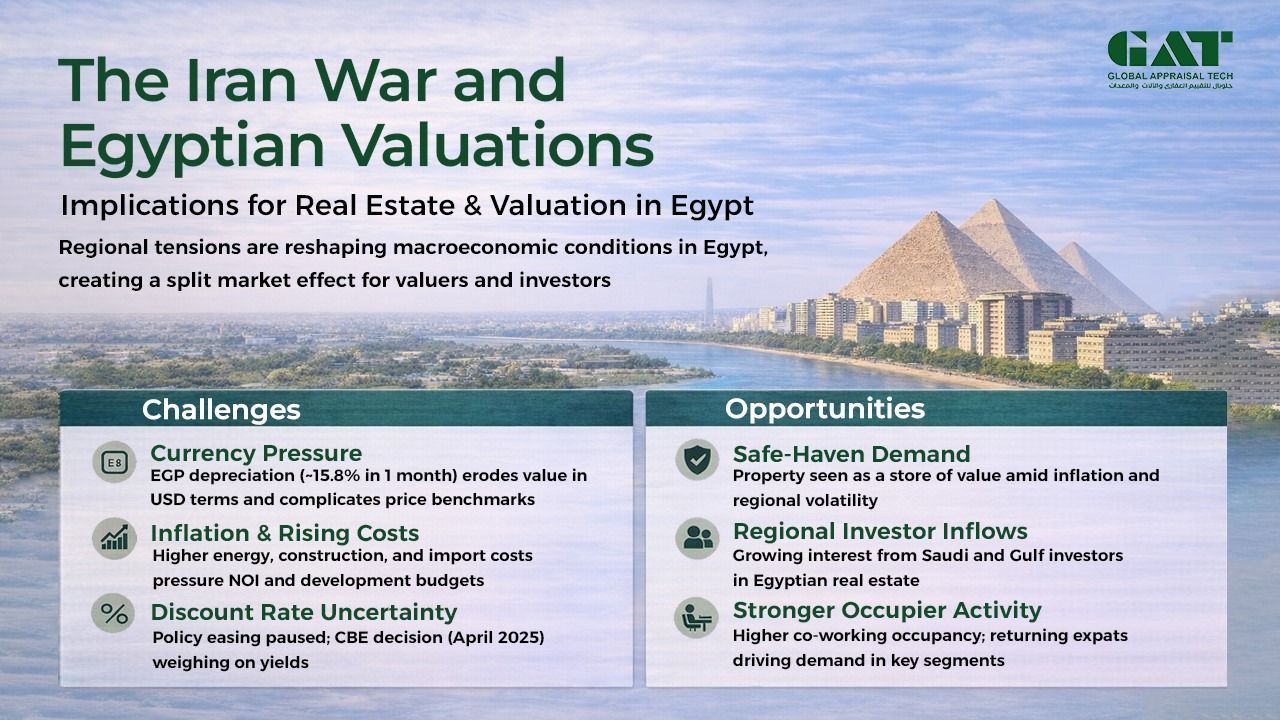
The Egyptian economy is particularly sensitive to regional instability because several of its strategic sources of foreign currency are exposed to geopolitical shocks. The disruption to shipping routes and the Red Sea corridor has already weighed heavily on the Suez Canal. At the same time, energy-related pressures have affected
fuel costs, gas supply, and the cost of running critical infrastructure. Inflationary risks are also intensifying as imported
goods, freight, and insurance costs rise.
These are not abstract macro concerns. They shape the real economy in ways that directly matter to valuation:
- higher transport and logistics costs,
- rising operating expenses,
- increased replacement costs,
- weaker purchasing power,
- and greater uncertainty over financing conditions.
For a valuer, that means the surrounding economic context is no longer background noise. It becomes part of the valuation judgment itself.
2. Real estate prices may rise, but value becomes harder to read
One of the most important consequences of this environment is that
nominal price growth can become misleading.
In periods of inflation and currency weakness, property prices in Egyptian pounds may continue to rise. At first glance, this may appear positive. But if the EGP is materially weakening against the USD, then the increase in local-currency pricing does not necessarily reflect real appreciation.
This is where valuation discipline becomes essential.
A valuer must distinguish between:
- nominal price movement, driven by inflation and currency pass-through;
- real value preservation, where the asset is merely holding purchasing power;
- and
genuine value growth, where the underlying asset is becoming more attractive or more productive in economic terms.
In other words, a higher asking price is not always a stronger signal of valuation.
This distinction matters greatly for investors, audit assignments, lending decisions, and fair value assessments. In volatile conditions, the market may be repricing for inflation rather than rewarding improved fundamentals.
3. Construction costs and development appraisals come under immediate pressure
The impact becomes even more direct when we move from standing assets to development appraisal.
War-related shocks affect the development process through several linked mechanisms:
- rising fuel and transportation costs,
- higher prices for imported and locally produced construction materials,
- more expensive shipping and marine insurance,
- supply chain delays,
- and greater uncertainty in contractor pricing.
For developers, this puts immediate pressure on cost plans. For valuers, it means development appraisals can become outdated very quickly if they rely on assumptions formed before the escalation in regional conflict.
And the issue is not limited to cost inflation alone.
Development appraisals also depend on assumptions around:
- sales rates,
- purchaser affordability,
- absorption periods,
- financing availability,
- and target developer margins.
In a stressed macro environment, all of these can shift at once. Costs rise, but the end-buyer may also become more cautious. Developers may raise prices to protect margins, while middle-income buyers delay decisions due to weaker affordability. That combination can produce a difficult market dynamic: higher nominal prices alongside slower market depth.
4. Discount rates are now a central issue
If there is one area where the valuation impact becomes especially serious, it is the treatment of discount rates.
Before a geopolitical shock, market participants may have expected a more stable inflation path and perhaps a softer interest-rate environment. But once war-related risk enters the picture, that expectation changes.
Even before any formal policy response, the market begins to reprice uncertainty:
- inflation expectations move upward,
- risk premiums widen,
- debt becomes more expensive or less certain,
- and the required return for development and investment decisions may rise.
This has immediate implications for valuation.
Discount rates used in
DCFs and development appraisals cannot be treated as
static.
Exit yields, financing assumptions, hurdle rates, and residual land values all become more sensitive in such an environment.
A relatively small shift in the discount rate can materially alter a development conclusion, particularly where projects have long delivery horizons or exposed cash flow timing. In practical terms, that means valuers should now place much greater emphasis on sensitivity analysis, scenario testing, and clear commentary on the rationale for rate selection.
5. At the same time, real estate can strengthen as a store of value
The picture, however, is not entirely negative.
In Egypt, real estate has long been viewed as a store of value in periods of inflation and currency weakness. That tendency can become even stronger during regional instability. Local investors often move toward hard assets when confidence in cash holdings weakens. In addition, Egypt may benefit selectively from regional capital seeking relative stability, especially if the domestic security environment is perceived to be more contained than elsewhere in the region.
This is where the market becomes more nuanced.
The same conflict that increases discount-rate uncertainty may also support demand in selected asset classes or geographies.
Prime residential, coastal assets, flexible workspace, and certain income-producing segments
may experience stronger interest from investors seeking inflation protection or capital preservation.
So the impact is not one-dimensional.
The Iran war is not simply “bad for real estate” or “good for real estate.” Rather, it creates a split market:
- some segments benefit from the flight to tangible assets,
- while others face affordability pressures, slower absorption, and rising required returns.
6. The valuer’s role becomes more important in volatile markets
This is exactly the type of environment in which valuation should add the most value.
When markets are calm, many participants focus mainly on comparable prices. But when macro volatility rises, the valuer’s role expands beyond simple evidence gathering. It becomes a question of
interpretation, judgment, and transparency.
In the current Egyptian context, valuers should be especially careful to:
- update assumptions more frequently,
- distinguish nominal EGP growth from real and hard-currency value,
- revisit replacement costs and construction contingencies,
- stress-test development appraisals,
- and be explicit about how inflation, currency, and risk are affecting the conclusion.
This is also the moment to communicate clearly with clients. A valuation conclusion today may be far more sensitive than usual to changes in one or two core assumptions. That should not be hidden. It should be explained.
7. Final thought
From an Egyptian perspective, the most important point is this:
The Iran war is not only influencing the market through sentiment. It is moving directly into the mechanics of valuation.
It is affecting cost assumptions, exchange-rate interpretation, inflation expectations, financing conditions, and discount rates. It is also reinforcing real estate’s role as a store of value for some investors, even as it heightens overall market uncertainty.
That is why this moment calls for greater valuation discipline, not less.
Headline prices may continue to rise. But for valuers, the real task is to determine whether that rise reflects genuine value, inflationary repricing, currency adjustment, or simply a market trying to protect itself from uncertainty.
And in today’s environment, that distinction matters more than ever.